How Much Should I Put Down on a Car?
The right car down payment is not the same for every buyer. A larger upfront payment reduces the amount you need to finance, which can lower your monthly payment and total borrowing cost. But putting too much cash into a vehicle can also leave less money available for insurance, registration, maintenance and unexpected expenses.
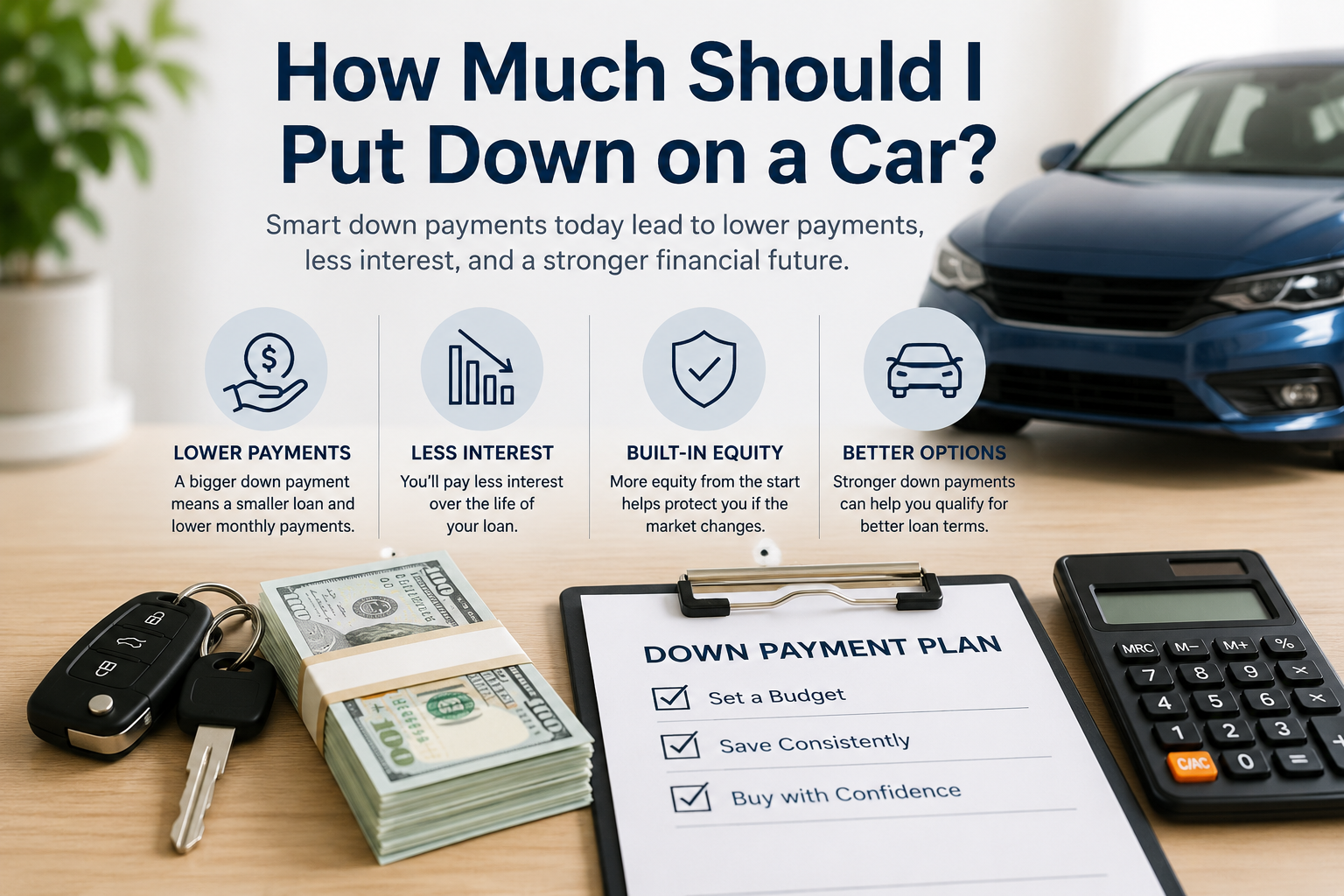
There is no single percentage that works for everyone. In general, putting more money down reduces the amount you borrow and your loan-to-value ratio. The best amount is one that meaningfully reduces the loan while still leaving enough cash for other purchase costs and your broader financial needs.
Estimate the Car Price That Fits Your Budget
Compare your payment budget, down payment, APR, loan term, trade-in value, taxes and fees before choosing a vehicle.
Use the Car Affordability Calculator →What Does a Car Down Payment Do?
A down payment is money or trade-in value applied upfront toward a vehicle purchase. Because that amount does not need to be borrowed, it can change several parts of your financing.
1. Reduces the Amount Financed
If a vehicle costs $30,000 and you put $6,000 down, the starting amount to be financed is $24,000 before accounting for taxes, fees, rebates, trade-in balances or other transaction details.
2. Can Lower the Monthly Payment
With the same APR and loan term, borrowing less generally produces a lower monthly payment. You can test different loan amounts with our Car Loan Finance Calculator.
3. Can Reduce Total Interest
Interest is charged on money you borrow. Reducing the principal at the beginning of the loan generally means less interest expense when the APR and term remain unchanged. Use our Car Loan Interest Calculator to compare scenarios.
4. Lowers Loan-to-Value Ratio
Loan-to-value, or LTV, compares the loan amount with the vehicle's value. A larger down payment can lower LTV, meaning you are financing a smaller share of the vehicle's value.
Is 20% Down on a Car Required?
No universal rule requires every car buyer to make a 20% down payment. The amount that makes sense depends on the vehicle price, lender requirements, financing offer, trade-in position, available cash and your budget.
The Consumer Financial Protection Bureau's guidance on auto-loan down payments explains that a down payment can consist of cash, net trade-in proceeds or both, and that putting more down reduces the amount that needs to be borrowed.
0% vs. 10% vs. 20% Down: Simple Examples
The table below shows how the initial amount financed changes at different down-payment levels. These examples intentionally exclude taxes, fees and other transaction costs so the effect of the down payment is easy to see.
| Vehicle Price | 0% Down | 10% Down | 20% Down |
|---|---|---|---|
| $20,000 | $20,000 financed | $18,000 financed | $16,000 financed |
| $30,000 | $30,000 financed | $27,000 financed | $24,000 financed |
| $40,000 | $40,000 financed | $36,000 financed | $32,000 financed |
For a $30,000 vehicle, moving from no down payment to 20% down reduces the starting financed amount by $6,000. Whether that is the best use of $6,000 depends on your financing terms and overall financial situation.
How a Down Payment Affects Monthly Payment and Interest
Consider a simplified $30,000 vehicle purchase financed for 60 months at 6.5% APR, with taxes and fees excluded. Approximate results are:
| Down Payment | Amount Financed | Approx. Monthly Payment | Approx. Total Interest |
|---|---|---|---|
| $0 | $30,000 | $587 | $5,219 |
| $3,000 (10%) | $27,000 | $528 | $4,697 |
| $6,000 (20%) | $24,000 | $470 | $4,175 |
These are illustrative estimates, not loan offers. Actual results depend on the exact APR, payment schedule, financed fees and lender calculations.
When a Larger Down Payment Can Be Helpful
- You want to reduce the amount borrowed and monthly payment.
- You want to reduce interest expense while keeping the same rate and term.
- You are trying to lower the loan-to-value ratio.
- You have substantial cash available after accounting for other purchase and ownership costs.
- You are trading a vehicle with positive equity that can be applied toward the purchase.
CFPB explains that lenders may use LTV when evaluating an auto loan and that increasing the down payment lowers the LTV. A high LTV can also increase the risk of owing more than the vehicle is worth.
When Putting Less Down May Be Worth Considering
A larger down payment is not automatically the best decision if it uses cash needed for other important expenses. Before committing most of your available savings to the purchase, consider upcoming insurance premiums, registration, maintenance, repairs and other obligations.
A low-down-payment offer should also be evaluated by its total cost rather than the monthly payment alone. APR, term length, add-ons and fees can materially change what you ultimately pay.
What About a 0% Financing Offer?
Zero-percent promotional financing can change the trade-off because the loan itself may not generate interest during the promotional financing term. However, advertised offers can have eligibility requirements and may compete with other incentives. Compare the complete transaction rather than assuming that either a larger down payment or a promotional rate is automatically best.
Can a Trade-In Count Toward the Down Payment?
Yes. Net trade-in value can function as part of the down payment. If your current vehicle is worth $10,000 and you owe $6,000 on it, the simplified net equity is $4,000. That equity may be applied toward the next vehicle.
If you owe more than the trade-in is worth, however, you have negative equity. Rolling that balance into a new loan increases the amount financed and can create a higher LTV. CFPB specifically warns that an LTV above the vehicle's value means you owe more than the car is worth.
Don't Forget Taxes and Fees
Your down payment is not necessarily the only cash needed at purchase. Sales tax, title and registration charges, dealer fees and optional products can affect both the amount due upfront and the amount financed. Rules vary by state and transaction.
Use our Car Sales Tax Calculator to model sales-tax assumptions, then run the resulting figures through the main loan calculator.
How to Choose Your Car Down Payment
- Start with a vehicle price that fits your overall budget.
- Estimate taxes, registration, fees and other upfront costs.
- Check the APR and term available from multiple financing offers.
- Calculate the loan with several down-payment amounts.
- Compare both monthly payment and total interest.
- Account for any positive or negative trade-in equity.
- Keep enough cash available for ownership costs and other financial needs.
CFPB recommends considering the broader costs of owning a vehicle—not only its list price or monthly payment—when deciding how much you can comfortably afford to borrow.
Compare Your Own Numbers
Change the down payment, vehicle price, APR and loan term to see how each variable affects your estimated financing.
Calculate Your Car Loan →Frequently Asked Questions
Is $5,000 a good down payment on a car?
It depends on the vehicle price and your financing. On a $25,000 vehicle, $5,000 equals 20% of the price; on a $50,000 vehicle, it equals 10%. Compare the resulting amount financed, payment and remaining cash rather than evaluating the dollar amount alone.
Can I buy a car with no down payment?
Some financing arrangements may allow little or no cash down, depending on the lender, borrower and transaction. Financing more of the purchase generally increases the loan amount and can increase the monthly payment and total interest when interest is charged.
Does a bigger down payment lower my interest rate?
It can. CFPB states that a larger down payment may reduce the interest rate charged, but lenders consider multiple factors when setting rates, including credit history, income, debts, loan amount and term.
Should I put 20% down or keep some savings?
That decision depends on your circumstances. A larger down payment reduces borrowing, while keeping cash available can help cover other purchase, ownership or unexpected costs. Compare the loan savings with the effect on your available cash.
Does a trade-in replace a cash down payment?
Positive net trade-in value can reduce the amount you need to borrow and can serve as part or all of the down payment. If the trade-in has negative equity, the effect can be the opposite.
Related Car Finance Calculators
Use these tools to compare your financing scenarios:
- Car Loan Finance Calculator — estimate monthly payments and total loan cost.
- Car Affordability Calculator — estimate a vehicle price from your payment budget.
- Car Loan Interest Calculator — compare interest costs.
- Car Loan Comparison Calculator — compare two financing options.
- Car Sales Tax Calculator — model vehicle sales tax assumptions.