When Should You Refinance a Car Loan? 7 Signs It May Make Sense (2026)
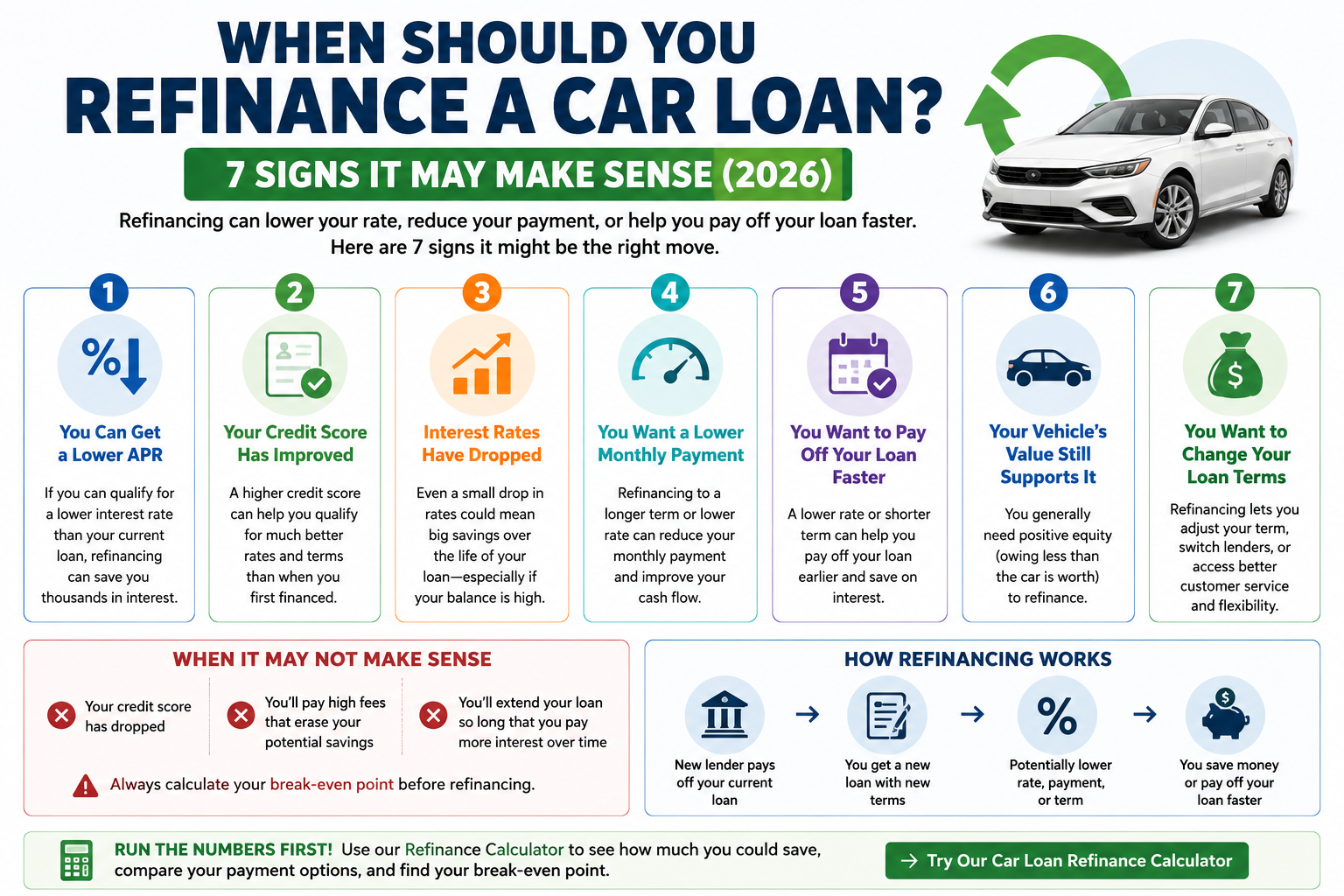
When should you refinance a car loan? Refinancing may make sense when a new loan can meaningfully improve your financing—such as lowering your APR, reducing interest cost, changing your monthly payment, or helping you reach a specific payoff goal. The key is to compare the new loan with what you still owe on your current loan, not with the loan you originally signed.
Check the Numbers Before You Refinance
Compare your current auto loan with a potential new rate and term to estimate the payment difference and potential interest savings.
Use the Car Loan Refinance Calculator →7 Signs It May Be Time to Refinance Your Car Loan
1. You Can Qualify for a Lower APR
A lower APR is one of the clearest reasons to consider refinancing. APR is especially useful when comparing loan offers because it reflects the interest rate plus certain lender fees. Even a modest rate reduction can matter when you still have a significant balance and plenty of time remaining on the loan.
2. Your Credit Profile Has Improved
If your credit profile has strengthened since you took out the original loan, you may receive better offers today. A stronger credit score does not guarantee a particular rate, but lenders generally use credit and other risk factors when setting loan terms. Compare multiple offers rather than assuming the first refinance quote is the best one.
3. Market Interest Rates Are More Favorable
Your personal credit is not the only factor. If available auto-loan rates have fallen since you financed the vehicle, refinancing could give you an opportunity to replace a higher-rate loan with a lower-rate one—assuming you qualify and the fees do not eliminate the benefit.
4. You Need a Lower Monthly Payment
Refinancing may reduce your monthly payment through a lower rate, a longer term, or both. But be careful with extending the repayment period. A longer term can make each payment smaller while increasing the amount of interest you pay over time.
5. You Want to Pay the Loan Off Faster
A shorter refinance term can help you become debt-free sooner. Your monthly payment may increase, but a lower rate combined with a shorter term can reduce interest cost. Make sure the higher required payment still fits comfortably within your budget.
6. Your Vehicle Value and Loan Balance Support Refinancing
Lenders may consider the vehicle's value, age, mileage, and your remaining balance. If you owe substantially more than the car is worth—known as negative equity—your refinance choices may be more limited or less attractive. Check your current payoff amount and a reasonable estimate of the vehicle's market value before applying.
7. Your Current Loan Terms No Longer Fit Your Goals
Your financial priorities can change. You may want a different payoff timeline, a more manageable required payment, or a loan from another lender. Refinancing can change the structure of the debt, but the new terms should improve your overall financial position rather than simply postpone repayment.
How Car Loan Refinancing Works
When you refinance, a new auto loan replaces your existing loan. The new lender generally pays off the old loan, and you then make payments under the new loan's rate, term, and conditions.
Find your current payoff balance, APR, monthly payment, and remaining term.
Shop for refinance offers and compare APRs, fees, terms, and eligibility requirements.
Compare the new loan's payment and total remaining cost with your current loan.
If you refinance, confirm the old loan is paid off and begin payments under the new agreement.
Car Refinance Example: How Much Could a Lower Rate Save?
Suppose you currently owe $25,000 with 48 months remaining at an 8.5% interest rate. For a simplified comparison, assume you can refinance the same $25,000 balance for the same 48 months at 5.5%, with no refinance fees.
| Current Loan | Refinanced Loan | |
|---|---|---|
| Balance | $25,000 | $25,000 |
| Rate | 8.5% | 5.5% |
| Remaining/New Term | 48 months | 48 months |
| Approx. Monthly Payment | $616.21 | $581.41 |
| Approx. Interest From This Point | $4,578.02 | $2,907.62 |
In this simplified example, refinancing lowers the payment by about $34.80 per month and reduces remaining interest by about $1,670.40. Real refinance offers may include fees, different loan terms, or other costs, so use your actual quotes before making a decision.
What Is the Break-Even Point on a Car Refinance?
If refinancing has upfront costs, calculate how long it takes for your monthly savings to recover those costs. A simple estimate is:
For example, if refinancing costs $400 and reduces your payment by $40 per month, the simple break-even point is about 10 months. This shortcut is useful for cash-flow comparison, but it does not replace a full total-cost comparison because changes in the loan term also affect interest.
When Refinancing a Car Loan May Not Make Sense
- The new APR is not meaningfully better. Small savings may disappear once fees are considered.
- You are extending the loan too far. A smaller payment can still produce a higher total interest cost.
- Your current loan has a prepayment penalty. Refinancing requires paying off the existing loan, so review your contract first.
- You have very little time left on the loan. There may be less remaining interest available to save.
- Your vehicle or loan does not meet lender requirements. Age, mileage, value, balance, and other underwriting rules can affect eligibility.
- Your credit or financial profile has weakened. The available refinance terms may be worse than your current financing.
Lower Payment vs. Lower Total Cost
This distinction is crucial. Imagine you have 36 months left on your loan and refinance into a new 60-month loan. Your required payment might fall substantially because the balance is being spread over more months. However, keeping debt outstanding longer can increase total interest even if the rate is lower.
The Consumer Financial Protection Bureau recommends comparing more than the monthly payment when evaluating auto loans. Important figures include the loan amount, APR and interest rate, term, and monthly payment. A longer term can lower the payment while increasing lifetime interest cost.
APR vs. Interest Rate When Refinancing
The interest rate is the price charged for borrowing the principal. APR is broader because it incorporates the interest rate plus certain additional loan fees. When comparing refinance offers, compare APR with APR rather than comparing one lender's APR with another lender's interest rate.
Before signing, review the Truth in Lending disclosures. These disclosures provide important information such as APR, finance charge, amount financed, total of payments, payment schedule, and applicable loan terms.
Does Your Current Loan Have a Prepayment Penalty?
Refinancing means your existing loan must be paid off. Depending on your contract and applicable state law, your current loan may have a fee for early payoff. Check the contract or contact the lender before calculating your final refinance savings.
How to Compare Car Refinance Offers
For each offer, write down the same set of numbers so you can make an apples-to-apples comparison:
- Current payoff balance
- New amount financed
- Interest rate and APR
- New loan term
- Monthly payment
- Origination or other required fees
- Total of remaining/new payments
- Estimated total interest
- Any prepayment penalty on the existing loan
Compare Your Current Loan With a Refinance
Enter your current balance, rate and remaining term, then compare them with a potential refinance offer.
Calculate Refinance Savings →Frequently Asked Questions
When should you refinance a car loan?
Consider refinancing when the new loan helps achieve a meaningful goal—such as a lower APR, lower total borrowing cost, more manageable payment, or faster payoff—after accounting for fees and the new loan term.
How much lower should my interest rate be to refinance?
There is no universal percentage that makes refinancing worthwhile for everyone. The benefit depends on your balance, remaining term, new term, fees, and rate difference. Calculate the dollar savings rather than relying on a fixed rate rule.
Can refinancing lower my monthly car payment?
Yes. A lower rate can reduce the payment, and extending the term can reduce it further. However, a longer term may increase the total interest you pay, so compare both monthly and total costs.
Can I refinance if I owe more than my car is worth?
It can be more difficult because the loan balance exceeds the vehicle's value. Eligibility depends on the lender and your overall application. Avoid assuming that rolling or extending negative equity automatically improves your finances.
Can I refinance the same car more than once?
Potentially, if a lender approves the new loan and refinancing makes financial sense. Each refinance should be evaluated independently for rates, fees, remaining balance, term, and total cost.
Should I refinance just to get a lower payment?
Not necessarily. A lower payment is useful for cash flow, but if it comes mainly from extending the loan, you could remain in debt longer and pay more interest overall.
Related Car Finance Calculators
Bottom Line
Refinancing a car loan can be useful when the new financing meaningfully improves your rate, total cost, monthly cash flow, or payoff strategy. But a lower payment by itself is not enough to prove that refinancing is a better deal. Compare the APR, fees, term, payment, and total remaining cost side by side before signing a new loan.
Disclaimer: This article and the calculators on this website are for general educational and estimation purposes only and are not financial, legal, tax, or lending advice. Actual rates, fees, loan terms, eligibility requirements, taxes, and savings vary by lender, borrower, vehicle, contract, and jurisdiction. Review your loan documents and lender disclosures before making a financial decision.