Lease vs Buy a Car: Which Is Better in 2026?
Lease vs buy a car is not simply a question of which option has the lower monthly payment. Leasing and buying create different costs, restrictions, and ownership outcomes. The better choice depends on how long you plan to keep the vehicle, how many miles you drive, your available cash, financing terms, expected vehicle value, and what matters most to your budget.
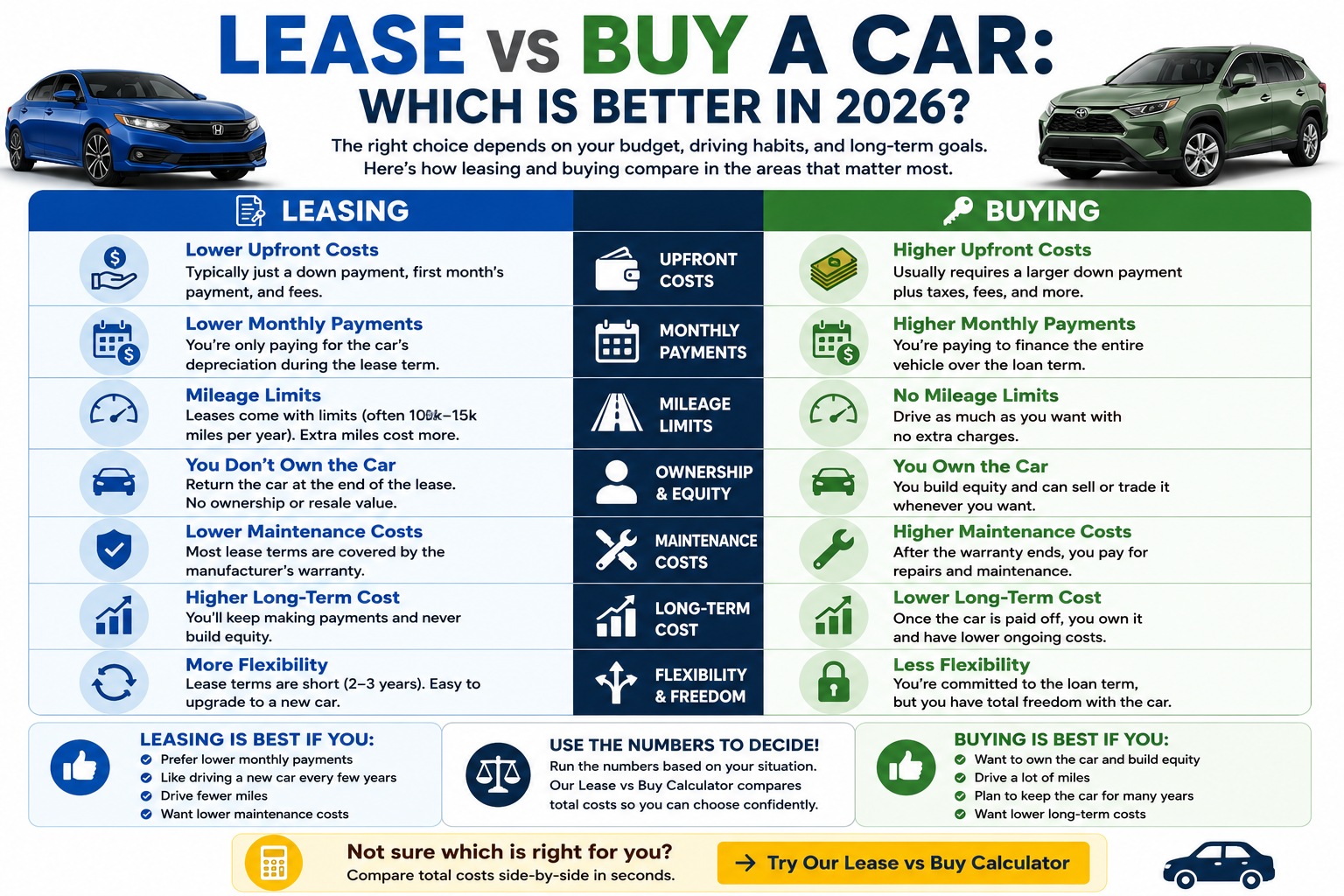
Compare Lease vs Buy Costs Side by Side
Use your own purchase price, loan terms, lease payment, upfront costs, lease term and estimated vehicle value to compare the two options.
Use the Auto Lease vs Buy Calculator →Lease vs Buy a Car: Key Differences
| Factor | Leasing | Buying |
|---|---|---|
| Ownership | You generally return the vehicle at lease end unless the agreement includes a purchase option. | You own the vehicle after the loan is fully repaid. |
| Monthly payment | May be lower because lease payments largely reflect depreciation during the lease plus rent charges, taxes and fees. | Loan payments repay the amount financed plus interest and applicable financed costs. |
| Mileage | Usually limited by the lease agreement. | No contractual mileage limit, although mileage affects resale value. |
| Equity | Regular lease payments generally do not build ownership equity. | Paying down the loan can build equity as the balance falls relative to vehicle value. |
| End of term | Return the car, pay applicable end-of-lease charges, or buy it if your contract provides that option. | Keep, sell, or trade the vehicle. |
| Early exit | Early termination can be expensive. | You may sell or trade the vehicle, but the loan payoff still must be satisfied. |
How Leasing a Car Works
A vehicle lease gives you the right to use a car for an agreed number of months and miles. You do not normally finance the entire purchase price in the same way as a traditional auto loan. A large part of the lease payment reflects the vehicle's expected depreciation during the lease period, along with a rent charge, taxes, and applicable fees.
The vehicle's estimated value at the end of the lease is called the residual value. That estimate is important because it helps determine the depreciation portion of the lease payment and may also influence the purchase price if your agreement includes a lease-end purchase option.
Common Lease Considerations
- Lease term, often measured in months
- Allowed annual mileage
- Capitalized cost or negotiated vehicle cost
- Residual value
- Money factor or rent charge
- Amount due at signing
- Taxes and acquisition or other fees
- Excess mileage charges
- Excess wear-and-use charges
- Early termination terms
- Purchase option and any related fee, if offered
The Consumer Financial Protection Bureau notes that many leases restrict mileage to roughly 10,000–15,000 miles per year and may impose charges for excess mileage or excessive wear. Always use the limits and charges stated in your actual lease contract rather than assuming a standard allowance.
How Buying a Car With a Loan Works
When you finance a purchase, an auto loan covers the amount you need to borrow after considering items such as your down payment and trade-in. You make scheduled payments that generally include principal and interest, along with any eligible costs or add-ons that were financed into the agreement.
Once the loan is fully repaid, you keep the vehicle. Unlike a lease, there is normally no contractual mileage allowance. However, higher mileage, age, condition, and depreciation can reduce the vehicle's resale or trade-in value.
1. Compare Monthly Payments — But Don't Stop There
Lease payments may be lower than loan payments for a comparable vehicle, which can make leasing attractive from a monthly cash-flow perspective. But monthly payment alone cannot tell you which choice is cheaper overall.
With a purchase, part of each payment reduces what you owe on an asset you can eventually own. With a lease, you are paying for use of the vehicle under the lease terms and normally return it at the end unless you exercise an available purchase option.
2. Compare Upfront Costs
Both options can involve money due at the beginning. A purchase may include a down payment, taxes, title or registration charges, and dealer fees. A lease may require an amount due at signing that can include items such as the first payment, acquisition fee, taxes, registration charges, or a capitalized-cost reduction.
Do not compare only a buyer's down payment with a lessee's advertised monthly payment. Use the complete amount of cash required to start each transaction.
3. Think About Mileage
Mileage is one of the biggest practical differences. If you routinely drive more than a lease allows, excess-mileage charges can change the economics of the deal. Buying gives you more freedom to drive as much as you choose, although additional mileage still affects depreciation and resale value.
Before leasing, estimate your annual driving realistically. A low-mileage lease can look attractive until your actual driving exceeds the contracted allowance.
4. Consider Ownership and Equity
Buying gives you the possibility of building equity. Equity is roughly the vehicle's market value minus the amount you still owe. It can be positive or negative depending on depreciation and how quickly the loan balance falls.
At the end of a lease, you generally do not own the vehicle merely because you made all scheduled lease payments. Depending on the agreement, you may return it or have the option to purchase it.
5. Compare Maintenance, Warranty and Wear Costs Carefully
Newer leased vehicles may spend much of the lease term under the manufacturer's warranty, but that does not mean maintenance is automatically free. The lessee remains responsible for obligations specified in the contract, and excess wear can lead to charges at lease end.
A purchased vehicle kept for many years may eventually require more out-of-warranty maintenance and repairs. On the other hand, after the loan is paid off, the owner can potentially enjoy years without an auto-loan payment. Actual maintenance costs vary significantly by vehicle, mileage, age, warranty coverage, and driving conditions.
6. Compare Flexibility
Leasing can make it convenient to move into another vehicle every few years at scheduled lease end, but it can be less flexible if you need to leave the contract early. The CFPB warns that early termination charges can be expensive.
Buying gives you the ability to keep, sell, or trade the vehicle when you choose, although selling a financed vehicle requires satisfying the lender's payoff amount. Negative equity can also complicate an early trade or sale.
7. Think About Long-Term Cost
Buying is often attractive to people who intend to keep a reliable vehicle well beyond the loan term because once the loan is paid, there are no more scheduled loan payments. That does not mean buying is always cheaper. Depreciation, interest, repairs, taxes, fees, insurance, resale value, and the length of ownership all matter.
Likewise, repeatedly leasing can mean continuing to have vehicle payments, but it may provide access to newer vehicles and different warranty exposure. A fair comparison should use the same time horizon and include the value of the purchased vehicle at the end.
Lease vs Buy Example
Suppose you are comparing buying and leasing a $35,000 vehicle. For the purchase, assume a $5,000 down payment, a 6.5% APR, a 60-month loan, and $500 in additional costs included in the simplified example. For the lease, assume $450 per month for 36 months, $3,000 due at signing excluding the first monthly payment, and $395 in lease-end fees. Assume the vehicle could be worth $23,000 after 36 months.
Our comparison calculator evaluates the purchase over the same 36-month period as the lease. For the buy option, that means considering the payments made during those 36 months and the estimated equity in the vehicle at the end—not pretending the 60-month loan has already been paid off.
This is why a lease-vs-buy decision can change when you adjust the vehicle's future value, financing rate, down payment, lease payment, mileage-related costs, or comparison period. Use realistic numbers from actual offers instead of relying on a universal rule.
When Leasing May Be a Better Fit
You expect to change vehicles every few years rather than keep one for a long ownership period.
You can comfortably remain within the contracted mileage allowance.
A particular lease offer provides a payment that better fits your budget after considering all upfront and end costs.
Mileage, condition standards, modification rules, and lease-end procedures fit the way you use a vehicle.
When Buying May Be a Better Fit
Your goal is to eventually own the vehicle without a loan payment.
You do not want contractual mileage limits or excess-mileage charges.
A long ownership period gives you more opportunity to use the vehicle after financing ends.
You want the option to sell or trade the vehicle and retain any positive equity.
Questions to Ask Before Signing a Lease
- What is the negotiated vehicle cost?
- What is the residual value?
- What is the lease term?
- How many miles are included each year?
- What is the charge for excess mileage?
- How is excessive wear defined and charged?
- What exactly is included in the amount due at signing?
- What are the acquisition and disposition fees?
- What are the early termination terms?
- Is there a purchase option, and what would it cost?
Questions to Ask Before Financing a Purchase
- What is the total vehicle price before financing?
- How much am I financing after the down payment and trade-in?
- What are the interest rate and APR?
- How long is the loan?
- What is the monthly payment?
- What are the finance charge and total of payments?
- Which optional add-ons are included?
- Is there a prepayment penalty?
For financed purchases, federal Truth in Lending disclosures provide important figures including APR, finance charge, amount financed, total of payments, and payment schedule. Review these figures before signing rather than evaluating the deal only by the monthly payment.
Run Your Own Lease vs Buy Comparison
Change the vehicle price, loan rate, term, lease payment, upfront costs, comparison period and expected vehicle value to see how the result changes.
Compare Lease vs Buy →Frequently Asked Questions
Is it cheaper to lease or buy a car?
There is no universal winner. Leasing may have a lower monthly payment for a comparable vehicle, while buying creates an ownership asset and can become attractive when the vehicle is kept for years. Compare total costs over the same period using your actual offers.
Do you own a car after a lease?
Normally, no. At lease end you generally return the vehicle. Some leases include a purchase option that allows you to buy it under the terms stated in the agreement.
How many miles can you drive on a lease?
The limit depends on the contract. The CFPB notes that many leases allow roughly 10,000 to 15,000 miles per year. Exceeding your specific allowance can result in additional charges.
Does buying a car build equity?
It can. Your equity is based on the vehicle's value compared with the amount you owe. Because cars depreciate, you can also have negative equity, especially earlier in a loan.
Is leasing better if I want a new car every few years?
It may fit that preference well because leases commonly run for a few years. However, compare the full cost and make sure the mileage, wear, and early-termination rules fit your driving habits.
Is buying always cheaper in the long run?
No. Keeping a purchased vehicle after the loan is paid off can reduce financing costs over a long ownership period, but actual results depend on depreciation, financing, maintenance, repairs, insurance, taxes, fees, resale value, and how often you replace vehicles.
Related Car Finance Calculators
Bottom Line
The best lease vs buy a car decision depends on more than the advertised payment. Leasing trades ownership for use of the vehicle under specific mileage, condition, and term requirements. Buying can create equity and eventually eliminate the loan payment, but it also exposes the owner to depreciation and potentially more maintenance as the vehicle ages.
Put both options on the same timeline, include all meaningful costs, account for the purchased vehicle's estimated value, and then choose the structure that best matches your budget and driving plans.
Authoritative resources: See the Consumer Financial Protection Bureau's guide to leasing versus buying and its guidance on comparing auto-loan offers.
Disclaimer: This article and the calculators on this website are for general educational and estimation purposes only and are not financial, legal, tax, or lending advice. Lease terms, loan rates, fees, taxes, vehicle values, mileage allowances, maintenance costs and eligibility vary. Review the actual lease or financing contract and disclosures before making a decision.