CAR FINANCE GUIDE
What Is Negative Equity on a Car? How It Works & What to Do (2026)
Updated September 2026
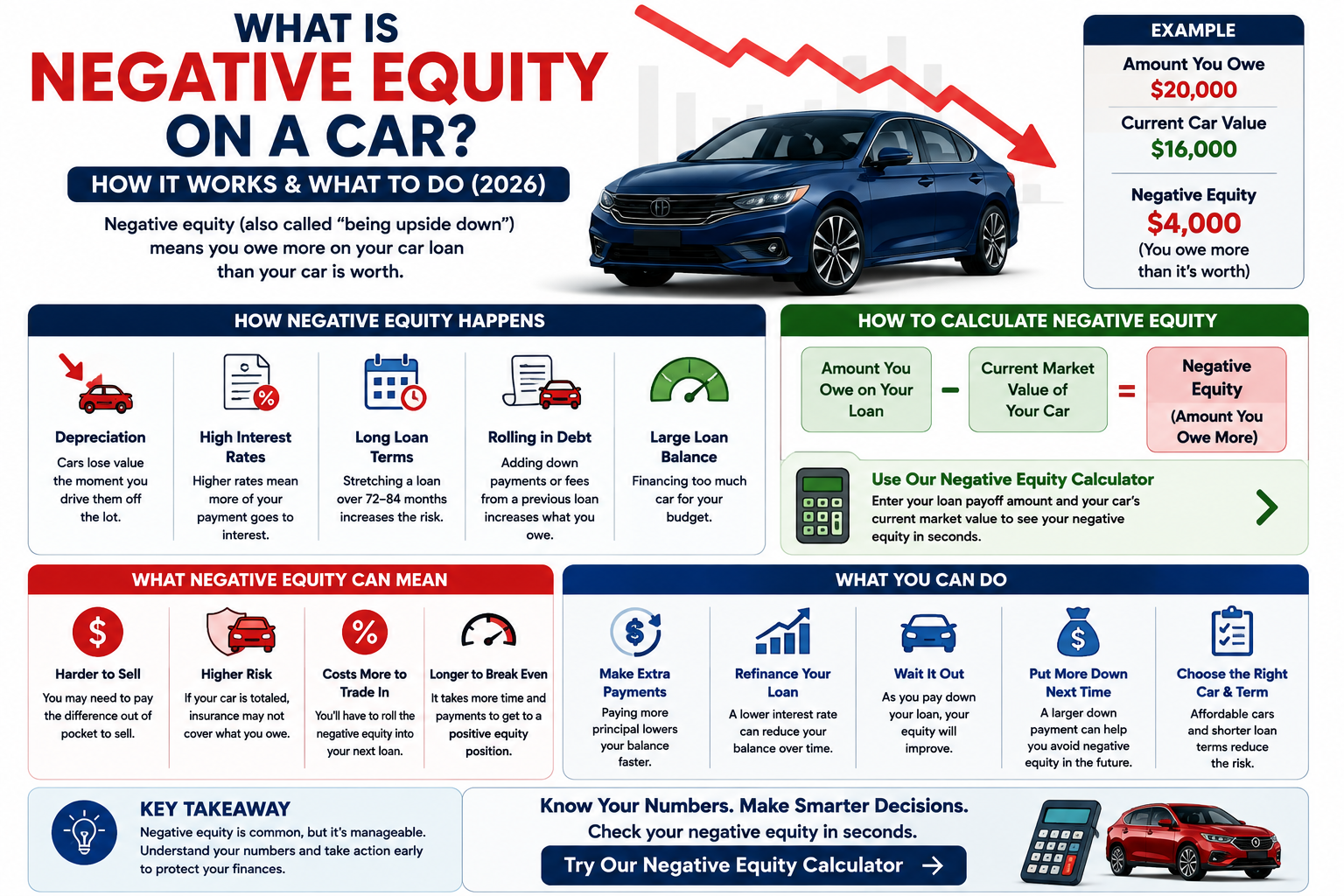
Negative equity on a car means you owe more on your auto loan than the vehicle is currently worth. It is also commonly called being “upside down” or “underwater.” Negative equity becomes especially important when you want to sell, trade, or refinance because the vehicle's value is not enough to fully pay off the loan.
How to Calculate Negative Equity on a Car
Ask your lender for the current payoff amount, then compare it with a realistic estimate of the vehicle's current value. The payoff amount can differ from a statement balance because of accrued interest, fees, or other charges.
Example: $20,000 payoff − $16,000 vehicle value = $4,000 negative equity. If the vehicle were worth more than the payoff, the difference would instead be positive equity.
What Is Loan-to-Value Ratio (LTV)?
Loan-to-value ratio is closely related to negative equity. It compares the amount of the loan with the vehicle's value.
Using $20,000 owed and a $16,000 vehicle value gives an approximate LTV of 125%. An LTV above 100% means the debt exceeds the vehicle value. Lenders can also consider LTV when evaluating a new loan or refinance application.
Why Does Negative Equity Happen?
1. Depreciation Outpaces Loan Paydown
Cars generally lose value over time. Early in a loan, the vehicle's market value can fall faster than the principal balance, particularly when little money was put down.
2. Small or No Down Payment
A smaller down payment means borrowing more and starting with a higher LTV. A larger down payment reduces the amount financed and provides more protection against early depreciation.
3. Long Loan Terms
Long terms can reduce the monthly payment but may pay principal down more slowly. They can also increase total interest and keep a borrower exposed to negative equity for longer.
4. Rolling Old Negative Equity Into a New Loan
If you owe $20,000 on a trade worth $16,000, the $4,000 shortfall does not disappear. If it is rolled into your next loan, you begin the next transaction borrowing $4,000 more than you otherwise would.
5. Financing Fees or Add-Ons
Financed taxes, eligible fees, service contracts, or optional products increase the loan balance but may not increase the vehicle's resale value by the same amount.
6. Falling Vehicle Value
Mileage, condition, accident history, demand, model-specific factors, and broader used-car market conditions can all affect what a vehicle is worth.
Why Negative Equity Matters
- Selling: sale proceeds may not be enough to satisfy the lender's payoff amount.
- Trading: rolling the shortfall into another loan increases the amount borrowed.
- Refinancing: a high LTV may limit approval or available terms.
- Total loss: an insurance settlement may be less than the amount still owed, depending on the policy and circumstances.
What Happens When You Trade In a Car With Negative Equity?
Suppose your payoff is $20,000 and a dealer offers $16,000 for the trade. The $4,000 difference must still be addressed. You might pay the shortfall separately or, if approved, finance some or all of it with the replacement vehicle.
Example: Rolling $4,000 Into the Next Loan
If the replacement vehicle costs $30,000 and $4,000 of old negative equity is added, the simplified amount being financed becomes $34,000 before considering taxes, fees, down payment, or other adjustments. You are therefore paying for part of the old vehicle through the new loan.
What Can You Do About Negative Equity?
Keep the Vehicle Longer
If the car still meets your needs and the loan is affordable, waiting can give you time to reduce principal. Whether you reach positive equity depends on how quickly the balance falls compared with the vehicle's changing value.
Make Extra Principal Payments When Appropriate
Extra principal payments can reduce the balance faster when permitted and correctly applied. Check your contract and lender procedures first. Test scenarios with the Car Loan Extra Payment Calculator.
Get Multiple Value Estimates
Compare realistic trade-in and sale estimates. A private sale may produce a different amount, but a financed vehicle has a lien that must be handled correctly with the lender.
Pay the Shortfall Instead of Rolling It Forward
If you must replace the car and can reasonably cover the shortfall, paying it separately prevents old debt from increasing the next auto loan.
Consider Refinancing Carefully
Refinancing does not erase negative equity. It replaces one loan with another, and a high LTV can make approval harder. If better terms are available, compare total cost with our Car Loan Refinance Calculator.
Should You Trade Now or Wait?
Start with three numbers: your exact payoff amount, a realistic vehicle value, and the cash you could reasonably use toward any shortfall. If the current vehicle remains suitable and affordable, waiting may help avoid carrying old debt into another loan. If replacement is necessary, make the negative equity explicit in your calculations and contract.
Negative Equity and Total-Loss Risk
If a vehicle is stolen or declared a total loss, insurance generally pays according to the applicable policy and covered vehicle value rather than automatically paying whatever remains on the loan. A difference may remain. Some borrowers have GAP coverage intended to address certain shortfalls, but coverage, exclusions, limits, and eligibility vary by contract.
How to Reduce the Risk Next Time
- Choose a vehicle that fits your total budget, not merely a target monthly payment.
- Consider a reasonable down payment to reduce the starting LTV.
- Avoid unnecessarily long loan terms.
- Review optional add-ons before financing them.
- Research likely depreciation and resale value.
- Know your current payoff and trade value before shopping.
- Compare APR, term, fees, and total borrowing cost across offers.
Know Your Loan Numbers
Estimate your payoff timeline and test extra-payment or refinancing scenarios before making a move.
Use the Car Loan Payoff Calculator →Frequently Asked Questions
What does negative equity on a car mean?
It means your loan payoff is greater than the vehicle's current value. Owing $20,000 on a car worth $16,000 creates about $4,000 of negative equity.
How do I know if I am upside down?
Get the lender's current payoff amount and compare it with a realistic vehicle value. If the payoff is higher, the difference is your approximate negative equity.
Can I trade in a car with negative equity?
Potentially. The shortfall still must be handled, either separately or, if approved, through new financing. Rolling it over increases the new amount borrowed.
Does a dealer pay off negative equity?
A dealer may arrange payoff of the old lender, but the shortfall may be included in your new financing. Review the amount financed and contract carefully.
Can refinancing fix negative equity?
It does not remove the equity gap. Better refinance terms may help in some situations, but high LTV can restrict available offers.
Will extra payments help?
Paying principal down faster can narrow the gap between the payoff amount and vehicle value, subject to your loan terms and how the lender applies extra payments.
Related Car Finance Calculators
Bottom Line
Negative equity on a car is the difference created when the loan payoff is higher than the vehicle's value. Before selling or trading, get the exact payoff, estimate the vehicle's value from multiple sources, calculate the gap, and understand exactly how any shortfall will be handled.
Authoritative resources: CFPB guidance on trading a car that is not paid off and CFPB guidance on auto-loan LTV.
Disclaimer: This article and website calculators are for general educational and estimation purposes only and are not financial, legal, tax, insurance, or lending advice. Vehicle values, payoff amounts, lender requirements, loan terms, fees, coverage, and laws vary.